When we’re in the office, we’re often faced with the dilemma of not having enough sockets to accommodate all our tech. Inevitably, when this happens we all resort to the trusty extension cable, but it’s important to note that there are some golden rules that need to be observed in order to avoid any accidents.
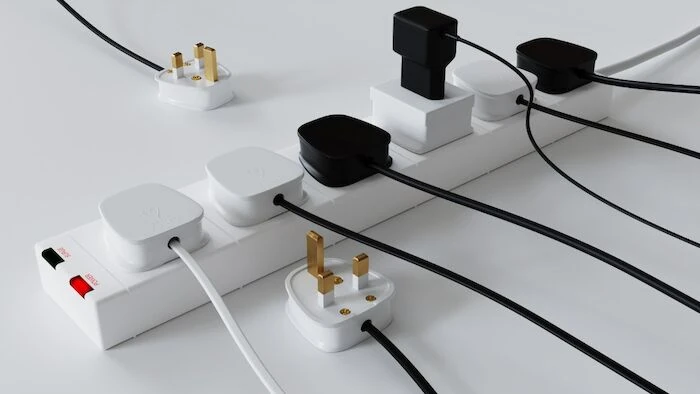
In a commercial context, the Electricity at Work Regulations 1989 state that every employer must provide their staff with a working environment that is safe. This applies across the board, from the use of machinery and the avoidance of trip hazards through to electrical safety. And this latter is becoming more complex due to the continual rise in the number of electrical appliances and technology being used on a daily basis.
Of course, the optimum approach is to have one plug per socket, but this approach can present problems if some appliances are to be used only occasionally and/or you may simply have too many items. The obvious answer is to reach for the extension lead, but misusing this solution can lead to an electric shock or even an electrical fire. So how do you use extension cables safely?
Choose the correct size
Extension leads come in two forms: a single socket version or a longer block with anything between two and ten sockets. It’s important to ensure that the cable you decide to use is suited to the load you’re planning for it. Ideally, keep the number of sockets to a minimum and avoid putting it under unnecessary strain.
Avoid tripping
It’s best to avoid extension cables that have an unnecessarily long lead as they can prevent a trip hazard. In addition, it’s important to lay the cable neatly to avoid it knotting up and to unwind it fully if it’s on a reel as that will reduce the risk of overheating.
Keep it straight
For convenience it can be tempting to run an extension cable round a corner or across a doorway, but this can be hazardous. If you do have to run the cable over the floor, it should be taped down and made conspicuous. And, as with all electrical items, an extension cable should be kept away from anywhere where water is present or where excessive heat and dust may also be an issue.
Going outdoors
Should you need an additional power source outside there are specific extension cables for this purpose and they are usually protected by an RCD (residual current device).
Keep it uncovered
Under no circumstances should an extension cable be covered with anything – whether that’s clothing, paper or rubbish – and sufficient air should be allowed to circulate around it to help to regulate its temperature.
If in doubt, take it out
If you’re at all concerned about the condition of the extension cable, remove it from service immediately and dispose of it responsibly. All extension cables should be PAT tested annually and should also have a regular visual inspection to ensure they’re fit for purpose.
Never daisychain
However tempting it might be, under no circumstances should you daisychain extension cables together by attaching one to another. Doing so places additional strain on the first cable and therefore increases the risk of an electrical fire.
Take the lead
Where the use of an extension lead is unavoidable, ensure that the one you select is fit for purpose as some cables are only suitable for lighting appliances, for example. Not only that, it’s vital to ensure that the total load for the extension cable is covered by the fuse that’s installed.
Test it
The Electricity at Work Regulations 1989 stipulate that all electrical appliances – including extension leads – must be PAT tested every 12 months, and it’s prudent to engage a qualified electrician to carry this work out.
Over the years Mark Smith, owner of MS Electrical Services, has regularly seen extension leads being misused and is keen to educate employers as to how to utilise them safely. ‘They are of course a really useful addition to any office, warehouse or factory, but extension leads need to be treated with respect,’ comments Mark. ‘The key things are to make sure that you’re using the right cable for the job, that you avoid overloading it and that you resist at all costs the temptation to connect one to another to give you more sockets. Additionally, testing your extension leads annually and giving them a regular visual inspection will definitely help to keep everyone in your workplace safe.’
At MS Electrical we offer PAT testing in Cambridge, so please contact us to request a no-obligation quotation.