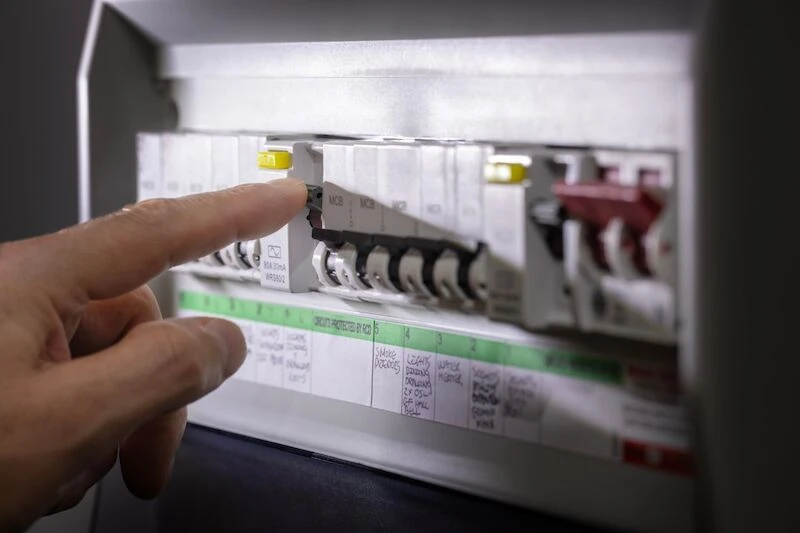
An EICR – or to give it its full name, an Electrical Installation Condition Report – is a formal document that’s created by a suitably qualified electrician on completion of the inspection and testing of a property’s fixed electrical wiring. In effect it serves as a ‘health check’ for the wiring, sockets, light fittings and fuse box to ensure that they’re all safe to be used.
To aid compliance and avoid confusion, here are the key facts about EICRs, some of which can occasionally be overlooked:
Safety
An EICR will identify any hazards such as the risk of fire, electric shocks, overloading and faulty earthing.
Testing
An EICR covers the consumer unit, the wiring and a percentage of sockets and lights. It’s important to note, however, that an EICR does not cover portable appliances such as toasters, microwaves or kettles, as these need to be PAT tested.
Compliance
Private rental landlords in England are mandated by law to ensure that any new tenancy since July 2020 and any existing tenancy since April 2021 has a valid EICR. In rental properties, the EICR must be carried out at least every five years. For privately owned homes, there is no legal requirement for an EICR, but we recommend that it’s carried out every ten years or when you are looking to buy a property. And for commercial properties, an EICR is required to ensure you’re compliant with the Electricity at Work Regulations 1989.
Findings
The EICR will rank your installation as 'Satisfactory 'or 'Unsatisfactory'. It will use several classification codes:
- C1 (danger present): This represents a risk of injury, so immediate action is necessary
- C2 (potentially dangerous): This indicates that urgent remedial work is required
- C3 (improvement recommended): This confirms that the installation isn’t inherently dangerous but that it does fall short of modern standards
- FI (further Investigation): This stipulates that more investigation work is needed
An EICR grades the installation as unsatisfactory if any C1, C2, or FI codes are found during the test.
Remedial work
If the EICR is unsatisfactory, landlords of domestic properties must complete all remedial work within 28 days, or even more quickly if the report specifies that.
Repercussions and record keeping
Failing to comply with regulations can result in a fine of as much as £30,000 which can grow to £40,000 in some cases. Landlords of domestic properties are required to give a copy of the EICR to new tenants before they move in and to existing tenants within 28 days of the inspection.
At MS Electrical we specialise in domestic and landlord EICRs in Cambridge. Simply call us on 01223 850301 or complete our enquiry form to request a no-obligation quotation.